Introducing the Latin Josephus Project 3.0
Texts, translations, and new tools for studying Josephus and his reception in the Latin Middle Ages
The Latin Josephus Project is pleased to announce the release of version 3.0 of its digital research platform, available freely at latinjosephus.org.
For more than a thousand years, the writings of the first-century Jewish historian Flavius Josephus were among the historical works most widely read in the Latin West. Medieval readers encountered his accounts of Jewish history and the destruction of Jerusalem in late-antique Latin translations and adaptations. They copied these works, annotated them, cited them, and sometimes understood their authorship in ways quite different from our own.
The Latin Josephus Project makes these texts accessible to modern readers and provides tools for exploring their transmission, interpretation, and relationship to the Greek originals.
Version 3.0 represents a major expansion and rebuilding of the project, which began in 2013. It brings together four major works, multiple textual traditions, historical and modern translations, and a new cross-corpus search interface.
Four works, multiple traditions
The project provides access to the principal works through which Josephus was known in the Latin Middle Ages:
- Antiquitates Judaicae (Jewish Antiquities), in twenty books, translated into Latin in the sixth century, in connection with Cassiodorus and his scholarly circle.
- Bellum Judaicum (Jewish War), in seven books, in a late-antique Latin translation of Josephus' account of the Jewish revolt against Rome.
- Contra Apionem (Against Apion), in two books, an important witness to ancient Jewish historical and apologetic writing.
- De excidio Hierosolymitano, in five books, a remarkable late-antique Christian reworking of the Jewish War, transmitted under the names of Josephus and, later, Hegesippus.
The Latin texts are accompanied by Greek texts and English translations where available, allowing readers to move between different versions of the same historical narratives.
Among the English texts are William Whiston's translations of Josephus, Thomas Lodge's 1602 translation of the Jewish War, and a new English translation of the De excidio Hierosolymitano, an AI product overseen by Richard Matthew Pollard. The De excidio can also be read in Pietro Lauro’s 1544 Italian translation and Jean Millet’s 1556 French translation.
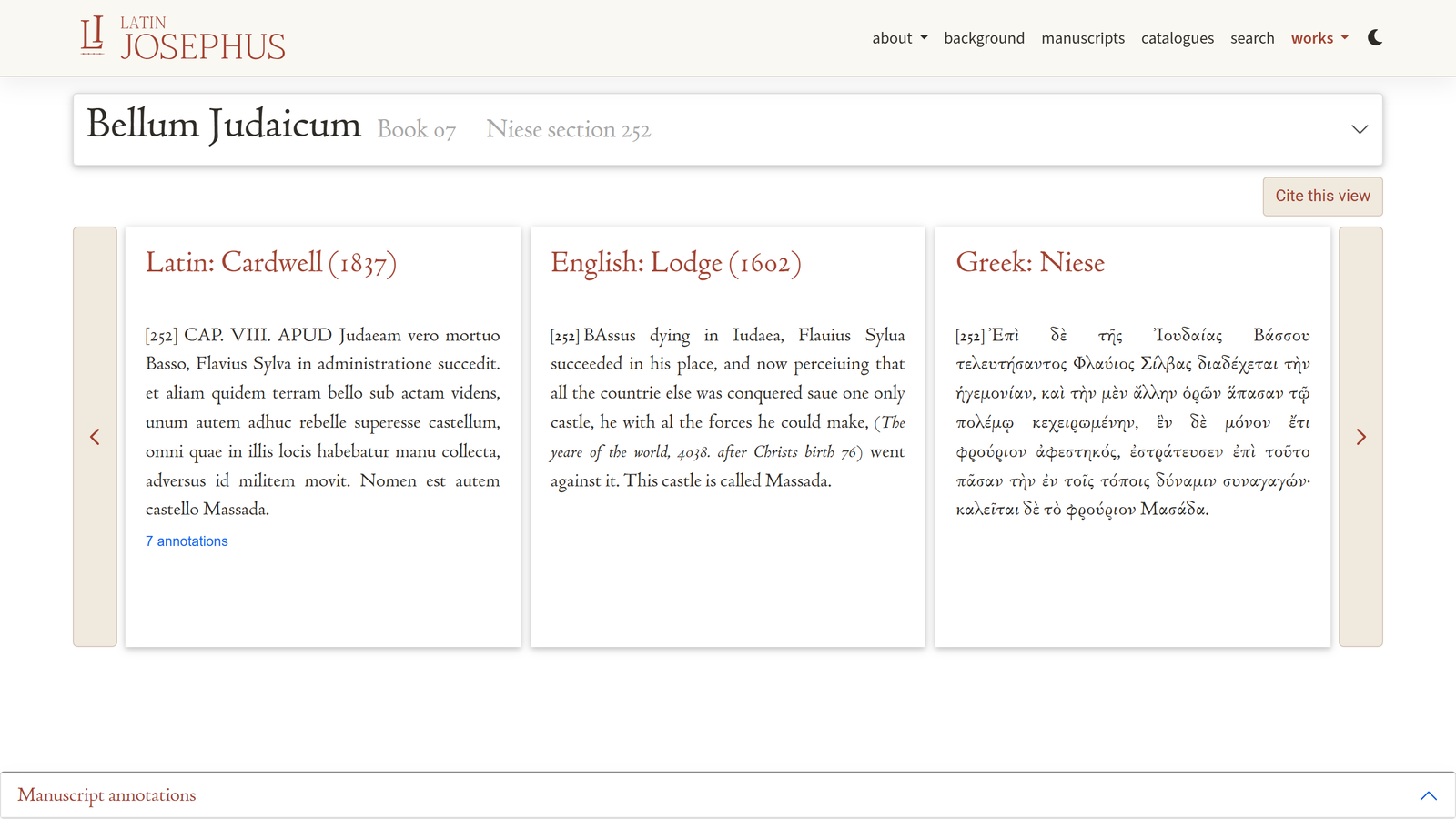
Josephus’ account of the advance on Masada appears in Niese’s Greek, Cardwell’s edition of the late-antique Latin translation, and Lodge’s English.
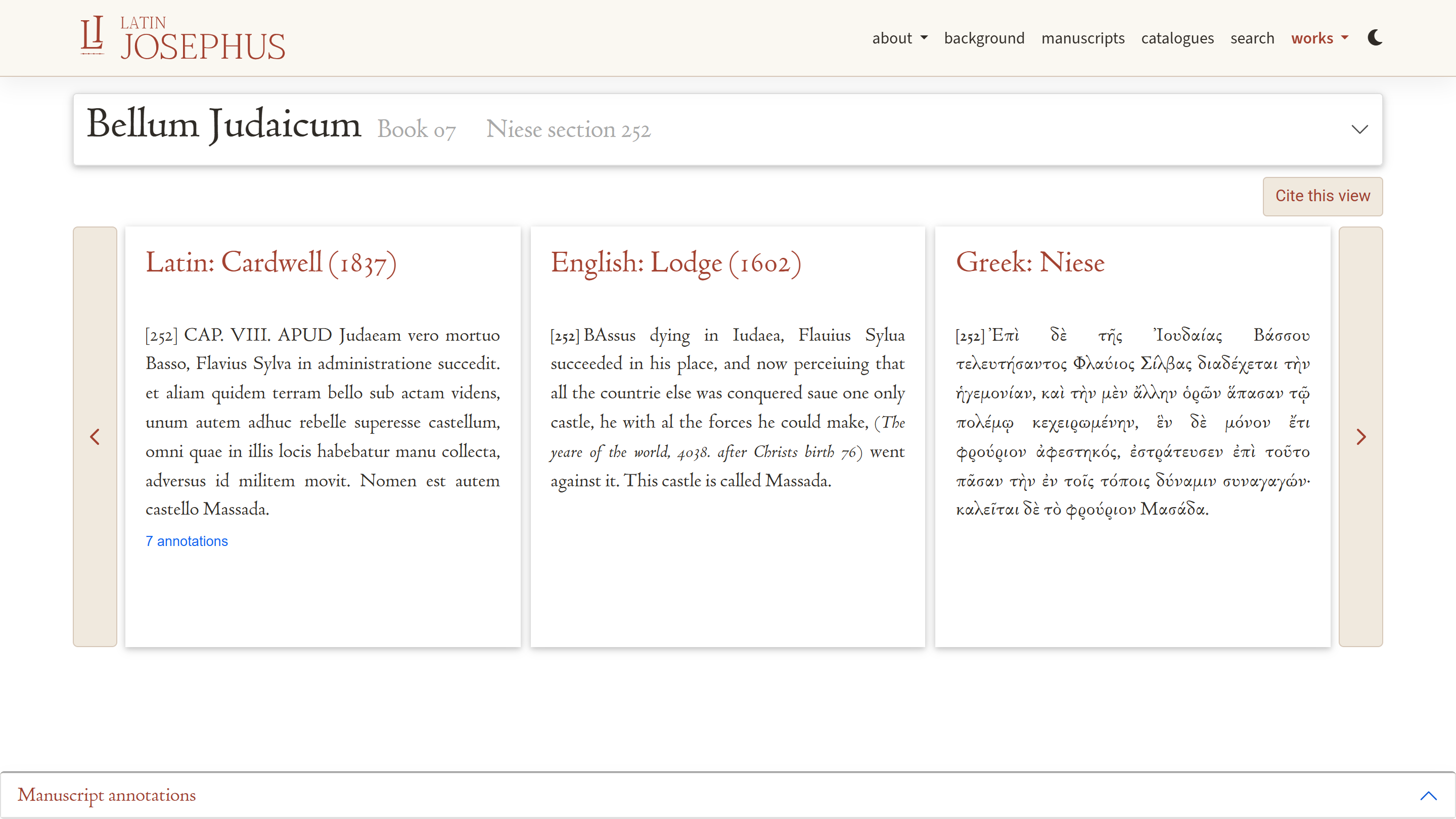
Image description
The reader header identifies Book 07 and Niese section 252. Each column begins with the same bracketed section number. The passage introduces Flavius Silva’s expedition after he succeeds Bassus. Lodge’s 1602 edition includes an italic chronological marginal note in parentheses. A link beneath the Latin text lists seven manuscript annotations.
Reading and comparing the texts
One of the project's central purposes is to make the Latin Josephus useful not merely as a collection of texts, but as a resource for comparative scholarship.
Readers can navigate by traditional textual divisions, compare different versions, and follow correspondences between passages.
Particular attention has been devoted to the relationship between the Bellum Judaicum and the De excidio Hierosolymitano. Although the latter draws extensively on Josephus, it is far from a literal translation: it transforms the narrative in its language, structure, and interpretation.
The new platform also provides a commentary for the De excidio that draws on more than 400 years of accumulated scholarship.
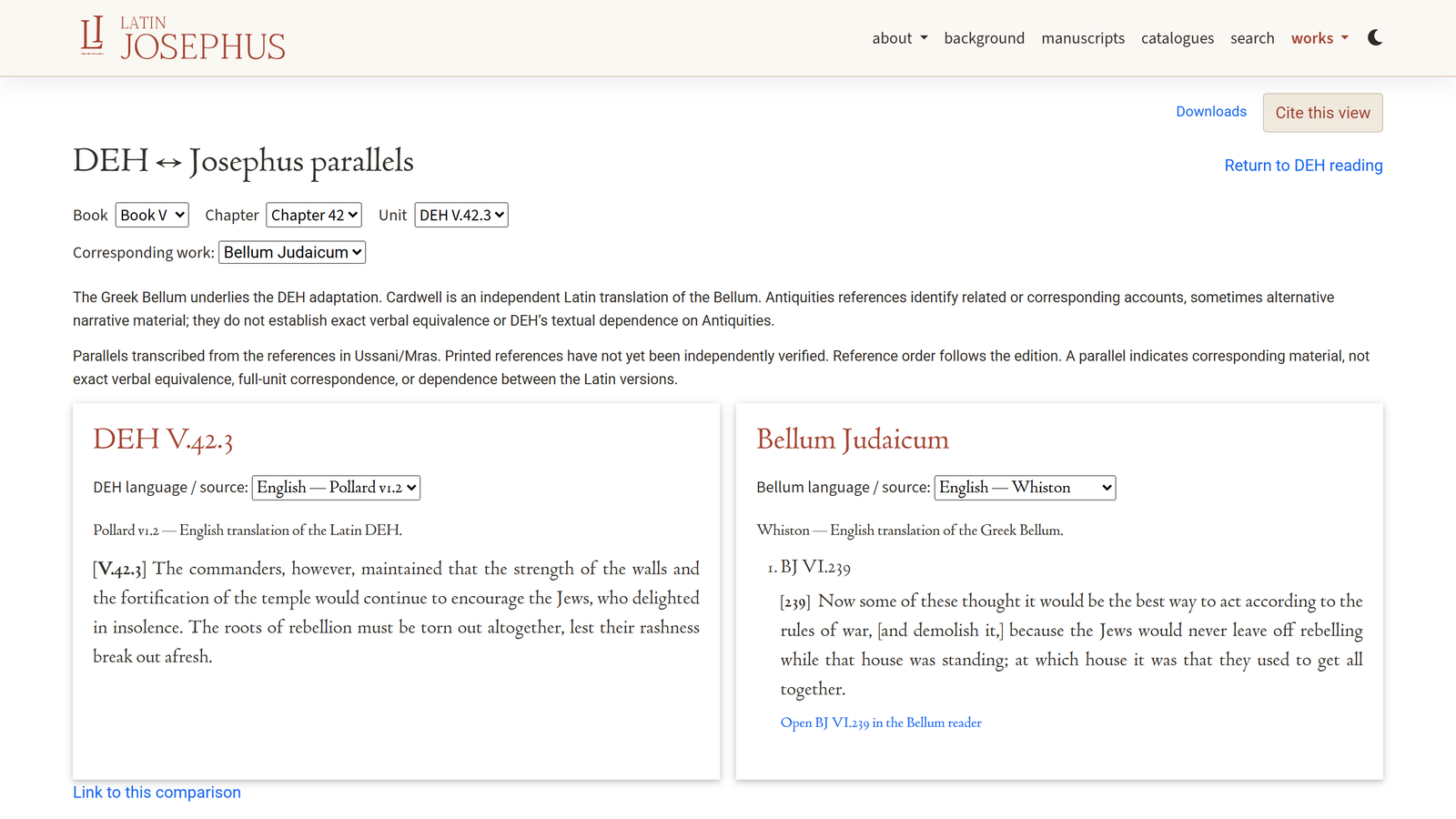
The De excidio recasts the Roman commanders’ argument for demolishing the Jerusalem Temple, shown alongside the corresponding passage in Josephus’ Jewish War.
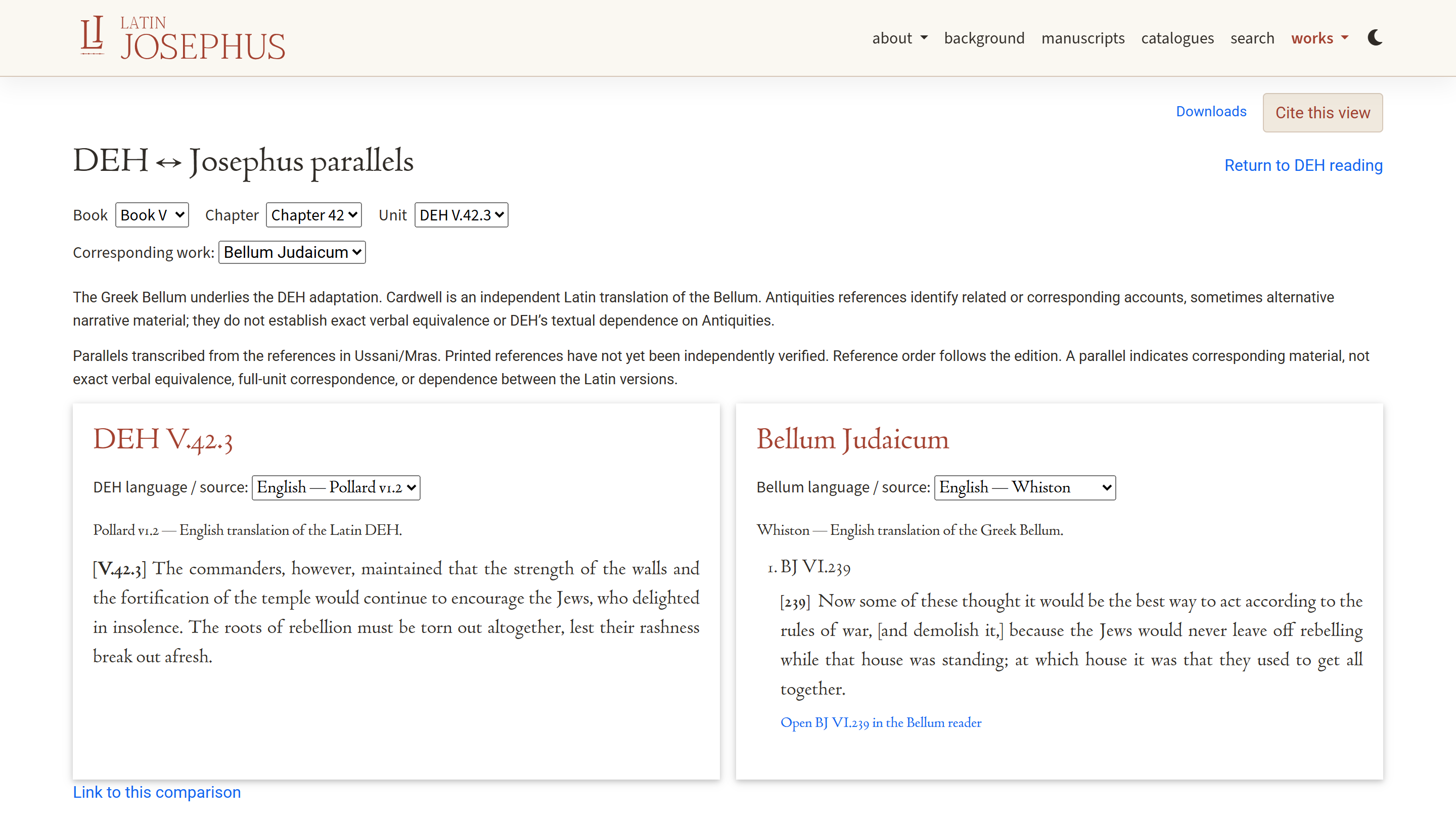
Image description
The source selectors identify Pollard’s English translation of De excidio (v1.2) on the left and Whiston’s English translation of Bellum Judaicum on the right. Josephus reports the argument that leaving the Temple standing would foster rebellion. The late-antique adaptation intensifies the commanders’ portrayal of the defenders and uses the image of uprooting rebellion. The right pane links to Niese section VI.239 in the Bellum reader.
A new cross-corpus search
Version 3.0 also introduces an expanded search system, allowing researchers to investigate vocabulary, passages, and recurring themes across the Latin, English, French and Italian texts, and even the medieval annotations.
The interface supports Boolean searches (AND, OR, NOT), exact phrases, wildcards, and searches that accommodate common variations in Latin spelling, including u/v and i/j.
Results can be restricted to particular works or books, examined in their textual contexts, and shared through persistent URLs.
These tools open new possibilities for studying the Latin reception of Josephus, tracing vocabulary and narrative relationships, and comparing the language of translations and adaptations.
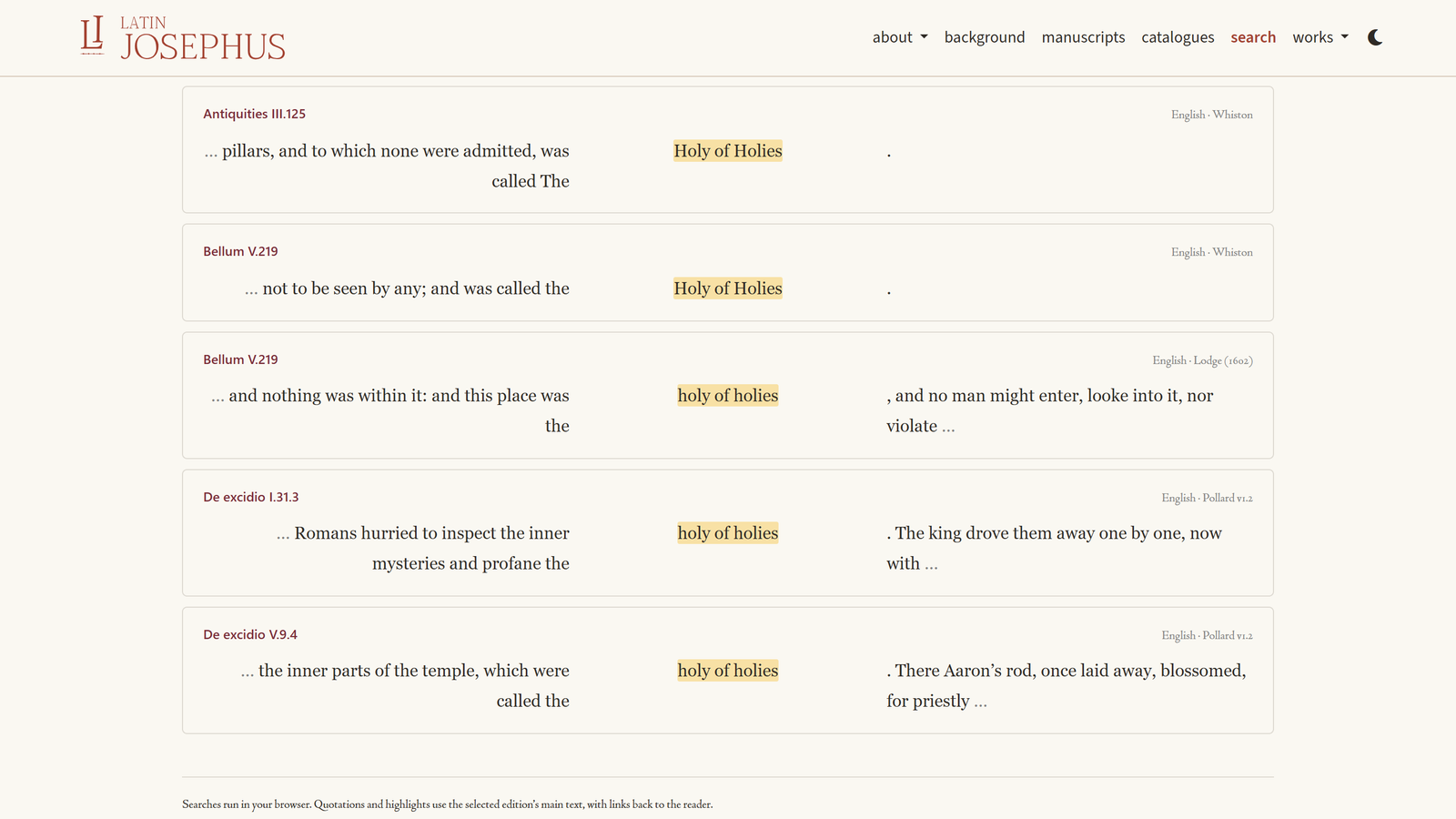
An exact-phrase search for “holy of holies” returns five concordance entries across Antiquities, Jewish War, and De excidio Hierosolymitano.
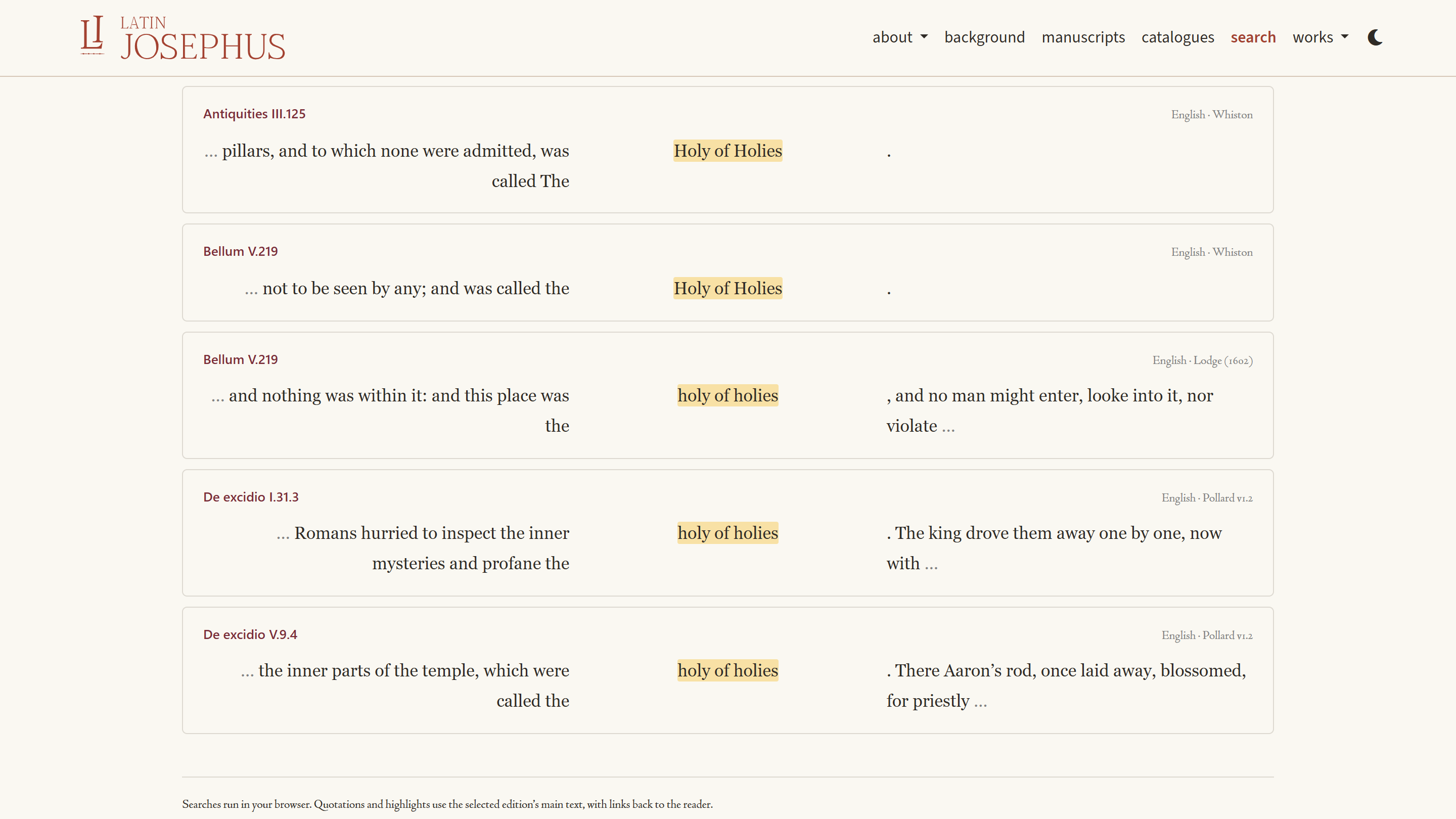
Image description
The concordance places the matching phrase between short excerpts and labels each row with a linked citation and a translation. From top to bottom, the rows show Whiston’s Antiquities III.125, Whiston’s and Lodge’s Bellum Judaicum V.219, and Pollard’s De excidio I.31.3 and V.9.4. The two Bellum rows let readers compare translations of the same section.
Medieval readers and their annotations
The Latin Josephus Project also investigates how medieval readers engaged with these works.
Its manuscript-based research, especially on the Latin Antiquities, incorporates transcriptions of early medieval annotations. These offer evidence of how readers selected, interpreted, corrected, and sometimes contested the historical and religious material they encountered.
The long-term ambition is to bring together the textual traditions and the surviving evidence of their medieval readership within a single research environment.
An evolving scholarly resource
The project has developed over more than a decade through the contributions of researchers and collaborators at the University of British Columbia and the Université du Québec à Montréal.
Version 3.0 continues this work while establishing a new technical foundation for further editions, transcriptions, translations, and research tools. The next step will be the incorporation of new manuscript witnesses, besides Bamberg SB Msc. Class. 78.
Each textual tradition has its own editorial history. The website identifies the editions and sources used, and distinguishes manuscript-based transcriptions from texts derived from printed editions.
The project welcomes corrections, suggestions, and collaboration.
Explore the project
Visit the Latin Josephus Project
Explore the texts, compare versions, and use the search interface to investigate the Latin Josephus and his medieval readers.